What is ERP Software? A Complete Guide for Modern Businesses
In today's digital economy, businesses are becoming increasingly complex. Companies must manage sales, finance, inventory, customer relationships, employees, and operational workflows simultaneously.
For many businesses, these processes are handled using multiple disconnected software systems. Accounting may be managed in one application, inventory in another, and customer data in a completely separate platform.
This fragmented approach often results in inefficiencies, duplicate data entry, poor visibility, and slow decision-making.
This is where ERP software comes in.
ERP, or Enterprise Resource Planning, is a type of business management software designed to integrate all core business processes into a single unified system.
Instead of operating multiple disconnected applications, companies use one platform to manage their entire organization.
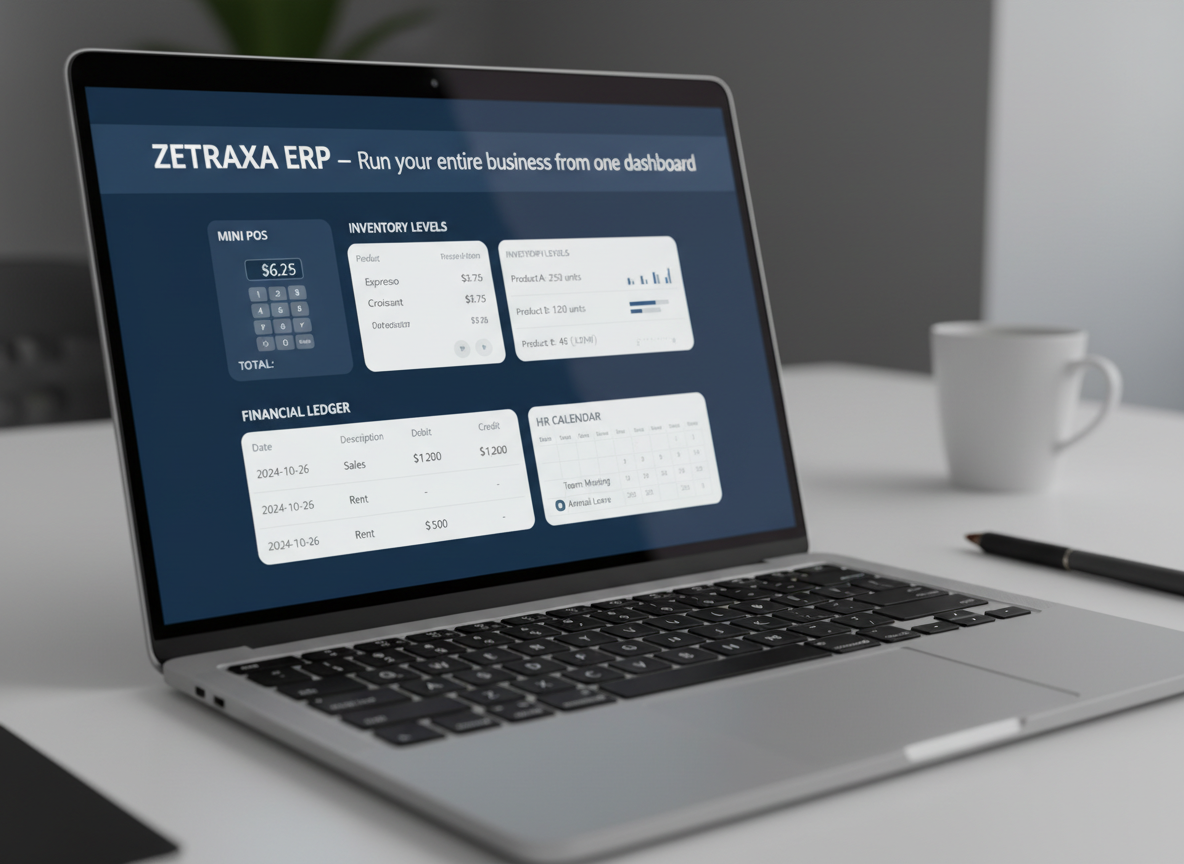
Modern ERP systems like Zetraxa ERP combine modules such as accounting, inventory management, POS, CRM, HR, procurement, and reporting into a single cloud-based platform.
The Evolution of ERP Systems
ERP systems have evolved significantly over the past few decades.
Early Business Systems
In the past, companies relied heavily on manual bookkeeping and spreadsheets. Each department managed its own data independently.
This approach created major problems:
-
Data duplication
-
Lack of transparency
-
High error rates
-
Slow reporting
As businesses grew larger, managing operations manually became impossible.
Traditional ERP Systems
The first ERP systems appeared in the 1990s and were primarily used by large corporations.
However, these early systems were:
-
expensive
-
complex
-
difficult to implement
-
dependent on on-premise servers
Small and medium businesses could rarely afford them.
Cloud ERP
Today, cloud-based ERP systems have transformed the market.
Modern solutions such as Zetraxa ERP operate directly through a web browser without requiring software installation.
This allows businesses to access their systems from anywhere while reducing infrastructure costs.
Core Components of ERP Software
ERP systems typically include several core modules that cover essential business functions.
1. Accounting and Financial Management
Financial management is one of the most critical aspects of any business.
ERP systems centralize financial data including:
-
revenue tracking
-
expense management
-
accounts payable and receivable
-
tax calculations
-
financial reports
With integrated accounting, businesses can monitor financial performance in real time.
2. Inventory Management
Inventory management ensures businesses always know what products they have available.
Advanced ERP inventory systems include features such as:
-
multi-warehouse tracking
-
stock history
-
product lot numbers
-
expiration tracking
-
automated stock alerts
For industries like pharmacies or food businesses, expiration tracking is particularly important.
Zetraxa ERP includes advanced stock management tools designed to track inventory across multiple locations.
3. Point of Sale (POS)
Retail businesses rely heavily on POS systems to process transactions.
ERP-integrated POS systems connect directly to inventory and accounting modules.
This means when a sale is made:
-
inventory automatically updates
-
financial records update
-
reports reflect the transaction instantly
This eliminates manual reconciliation work.
4. Customer Relationship Management (CRM)
CRM tools help businesses manage customer relationships and sales pipelines.
A CRM system typically includes:
-
lead tracking
-
follow-up reminders
-
sales pipeline management
-
quotation management
-
marketing campaign tracking
Zetraxa includes CRM functionality designed to track the entire lead lifecycle.
5. Human Resource Management (HR)
Employee management is another critical part of ERP systems.
HR modules typically manage:
-
employee records
-
attendance tracking
-
payroll
-
leave management
-
department structures
Zetraxa provides built-in HR management features including attendance, payroll, and department management.
Benefits of ERP Software
Businesses adopt ERP systems because they provide several key advantages.
1. Centralized Data
ERP systems store all business data in a single database.
This eliminates data silos and ensures that all departments work with the same information.
2. Automation
ERP systems automate many routine business tasks such as:
-
invoice generation
-
stock updates
-
financial calculations
-
payroll processing
Automation reduces human error and increases productivity.
3. Real-Time Reporting
Business owners need accurate information to make strategic decisions.
ERP systems provide real-time reports that show:
-
sales performance
-
inventory levels
-
financial health
-
operational efficiency
4. Scalability
As businesses grow, their operational complexity increases.
ERP systems allow companies to scale operations by adding new users, branches, and modules.
Zetraxa ERP supports multi-branch operations and centralized inventory management across locations.
5. Cost Reduction
Although ERP systems require an initial investment, they often reduce operational costs by:
-
eliminating redundant software
-
reducing manual labor
-
improving inventory control
-
preventing financial errors
Industries That Use ERP Systems
ERP software is used across many industries including:
-
Retail and wholesale
-
Healthcare and pharmacies
-
Restaurants and hospitality
-
Manufacturing
-
Logistics and distribution
-
Construction
-
Professional services
Zetraxa ERP supports many of these industries through specialized modules and workflows.
Why Cloud ERP is the Future
Cloud ERP systems are rapidly replacing traditional on-premise systems.
Advantages include:
-
remote accessibility
-
automatic updates
-
lower infrastructure costs
-
faster deployment
-
improved security
With cloud ERP systems, businesses can start small and scale their systems as they grow.
Conclusion
ERP software has become an essential tool for modern businesses.
By integrating accounting, inventory, CRM, HR, and operations into a single platform, ERP systems provide a clear and unified view of business performance.
Solutions like Zetraxa ERP allow companies to automate operations, improve decision-making, and scale efficiently.
For organizations seeking long-term growth and operational efficiency, implementing an ERP system is one of the most impactful technology investments they can make.